Home › Salt Lake City › Bill higher than insurance
Water Restoration Company Billed More Than Insurance Paid? What Utah Homeowners Can Do
Do this now
- Don't pay the balance yet, and don't ignore it. Reply in writing to say you're reviewing the bill.
- Find the contract or work authorization you signed and read the parts about price and payment.
- Ask for the itemized invoice, moisture readings, drying logs, and photos, in writing.
- Get your insurer's estimate and payment breakdown so you can compare them line by line.
- Save everything: texts, emails, call logs, and your own photos.
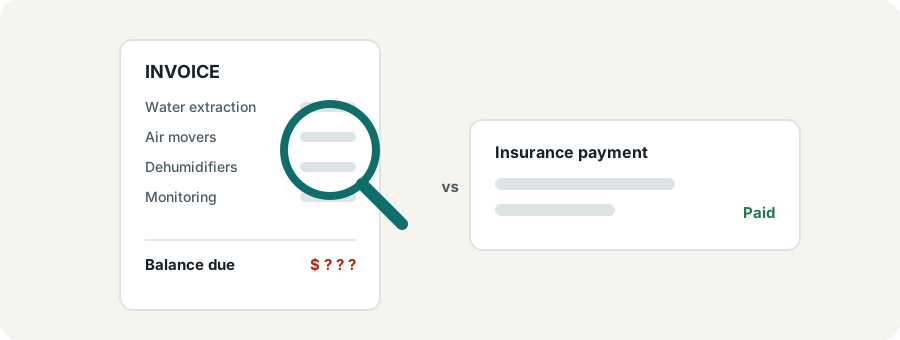
You thought the hard part was over. The water is gone, the fans are quiet, and insurance paid the claim. Then a bill shows up for thousands more than you expected. Maybe someone told you insurance would take care of it. It's normal to feel shocked, angry, or even tricked. Take a breath. A bill like this doesn't always mean you owe every dollar on it. You can ask questions, see the records, and push back calmly. This guide walks you through it, one step at a time.
We're a free referral service, not a restoration company. We're paid by our call-routing partner when you call through our site and get connected to a provider. We don't control providers' prices or billing.
This is general information, not legal advice. For advice about your situation, talk to a Utah attorney.
This happens in Utah, too
In December 2019, KUTV's consumer reporter covered a Taylorsville homeowner whose house flooded from a faulty water line behind her washing machine. The restoration company billed nearly $8,500. Her insurer said the cleanup shouldn't have cost more than $5,323.60. The company then sent her a bill for the roughly $3,000 difference. She said she'd been told insurance would cover the cleanup. She also showed that the bill included extra fans that weren't used, plus interest charged earlier than her contract allowed. The company called those "honest mistakes" but said it still expected to be paid (KUTV, 2019).

The Utah Insurance Department has warned about this exact problem. It says a contract that leaves the price open can make you responsible for everything insurance doesn't cover, which can add up to thousands of dollars. Its advice is simple: "Know what it is going to cost before you sign" (Utah Insurance Department).

Step 1: Read your contract or work authorization
Restoration crews usually ask you to sign something on day one, before they start work. It may be called a work authorization, service agreement, or contract. Find your copy. If you don't have one, ask the company for it in writing.
Look for:
- Price terms. Is there a set price, a price list, or no price at all?
- Who pays what. Does it say you owe anything insurance doesn't pay?
- Interest and late fees. When do they start?
- Assignment of benefits. Did you sign over your insurance payments to the company? If you did, the company may deal with your insurer directly, and the contract may still say you owe any balance. Read this section closely.
- Blank spaces. Were any filled in after you signed?
Write down what you find. That way, you'll know where you stand before you talk about money.
Step 2: Ask for the full paper trail
It's fair to ask what each charge is for. Send a written request (email works) for:
- An itemized invoice, with each line, quantity, and price
- Moisture maps and moisture readings for each day
- Drying logs showing which equipment ran, where, and for how long
- Before, during, and after photos
- Crew time records, if labor is billed by the hour
Good drying work should be documented. A 2026 restoration trade column says daily monitoring "should show change over time," with readings tied to the same spots, meters, dates, and technicians (Cleanfax, 2026). If a company billed for many days of drying but can't show readings, that's worth asking about.
Step 3: Compare the bill to what insurance paid
Ask your insurer for its estimate and a breakdown of what it paid. Then put the two side by side.
Many insurers price claims with Xactimate. Think of it as a giant price book for repair work. Each task, such as running one dehumidifier for one day, has a line item and a local price. United Policyholders, a nonprofit consumer group, explains that price lists are regional and that "in most regions, a new pricelist is generated monthly" (United Policyholders).
The same group notes that Xactimate estimates are often lower than contractor estimates, which leads to many disputes (United Policyholders). So a gap doesn't automatically mean someone is lying. It often comes from one of three things:
- Different prices for the same task
- Different amounts, like more days, more fans, or more square feet
- Items the insurer didn't accept, like a service it didn't think was needed
Mark each line where the numbers differ. Those are your questions.
Here's a simple example of what that comparison can look like (quantities only, for illustration):
| Line item | Company billed | Insurer accepted | Why they differ |
|---|---|---|---|
| Fans (air movers) | 6 fans × 7 days | 3 fans × 4 days | Count and days |
| Dehumidifiers | 2 × 7 days | 2 × 4 days | Days |
| Antimicrobial treatment | Billed | Not accepted | Insurer didn't think it was needed |
| Labor | 11 hours | 4 hours | Hours |
Step 4: Look for padding
Go through the invoice slowly. Watch for:
- Equipment counts. The Utah Insurance Department suggests paying attention to "the numbers and size of equipment" crews use, so you can tell if the bill is right (Utah Insurance Department). Do the fans and dehumidifiers on the bill match what you saw?
- Equipment days. Was equipment billed for days after it was picked up?
- Labor hours. Do the hours match how long the crew was actually at your house?
- Services you didn't get. Were you billed for treatments, cleaning, or removal you never saw happen?
- Fees you never agreed to. Do interest or late fees start sooner than the contract allows?
Check it against your own photos, texts, and calendar. In the KUTV case, the homeowner showed that some billed fans weren't used, and the company called the errors "honest mistakes" (KUTV, 2019).
Step 5: Negotiate in writing
Keep it calm and keep it in writing. A paper trail can help protect you if things go further. Stick to the facts, too. Allstate's tips, reported by KUTV, warn that inflating a loss can be insurance fraud (KUTV, 2019).
Here's a sample message you can adapt:
Hi [Company name],
I received invoice #[number] dated [date] for $[amount]. My insurance company paid $[amount], leaving a balance of $[amount]. I'm not refusing to pay what I owe, but I need to understand the charges first.
Please send me the itemized invoice, daily moisture readings, drying logs, an equipment list with dates, and job photos.
I have questions about these lines: [list them, for example, "6 fans (air movers) for 7 days; I counted 3, and they were removed on day 4"].
Please don't send this account to collections or add fees while we sort this out. I'd like to resolve it fairly. Thank you.
[Your name, address, and claim number]
Send it by email or certified mail, and keep a copy.
Once you have the records, ask the company to remove charges that don't hold up, or to accept the insurer's price for disputed lines.
Step 6: Ask your insurer to take another look
Call or email your adjuster and ask whether they'll review the claim again. Ask whether the restoration company can send the insurer a supplement, which is a request for more money with proof attached. If the company has records your insurer never saw, those could change the picture.
Ask the insurer to explain, in writing, why it denied or cut any line. Our guide to Utah water damage claims covers how to challenge a low payout, including appraisal. If you think the insurer handled your claim unfairly, you can complain to the Utah Insurance Department (see Step 8).
Step 7: If you get a lien or intent-to-lien letter
Some companies send a letter saying they plan to file a lien, which is a legal claim against your home. It can make selling or refinancing harder. Take it seriously, but don't panic.
Utah has a law called the Residence Lien Restriction and Lien Recovery Fund Act. According to the state, it generally protects homeowners who have a written contract with a licensed or exempt contractor, have paid the full contract price, and meet other conditions, such as occupying the home within 180 days after the work is completed (Utah Division of Professional Licensing). If you're disputing part of the bill and haven't paid in full, that protection may not apply to you. Whether it fits your case is a legal question.
If a lien letter arrives, we suggest talking to a Utah attorney soon. Lien rules have deadlines. The Utah State Bar's Find a Lawyer page can point you to attorneys by practice area.
Step 8: Where to complain in Utah
If talking with the company doesn't work, these groups may help. Each one handles a different part of the problem.
- Utah Insurance Department. Complaints about your insurance company. The department sends your complaint to the insurer, reviews the reply, and shares its findings. The process usually takes three to four weeks (Utah Insurance Department). File a complaint.
- Utah Division of Consumer Protection. Complaints about a business using unfair or misleading sales practices. The division enforces Utah's Consumer Sales Practices Act (Utah Division of Consumer Protection). File a complaint.
- Utah Division of Professional Licensing (DOPL). First, use the license lookup to see if the company or its contractors hold a Utah license. Some water extraction and drying work may not require a contractor license, but repair and rebuild work usually does. If you're unsure, ask DOPL. You can file a complaint about a possible licensing law violation. Note that DOPL says it won't act as your attorney to recover money or settle disputes.
- Better Business Bureau. A BBB complaint can help start a conversation with the company.
Signs of a trustworthy company vs. red flags
| A trustworthy company... | Red flags |
|---|---|
| Explains the price, or how it will be set, before you sign | Contract with blank spaces or no price at all |
| Gives you a copy of everything you sign | Pressures you to sign before you can read it |
| Takes daily moisture readings and shares them | Can't show readings or drying logs |
| Lists equipment with counts and dates | Bills for more fans or days than you saw |
| Tells you plainly that you may owe what insurance doesn't pay | Promises insurance will cover everything |
| Answers billing questions in writing | Stops responding, or jumps straight to lien threats |
| Asks for a modest deposit, if any | Wants full payment up front or cash only |
How to avoid this next time
For the full list of questions to ask and how to check a license, see how to choose a water damage company in Salt Lake City.
- ☐ Take photos and video of the damage before cleanup starts, if it's safe.
- ☐ Call your insurer yourself and ask for its list of "preferred" companies (Utah Insurance Department).
- ☐ Ask anyone who refers a company whether they get paid for it. The state says some plumbers have been paid up to $1,000 per referral (Utah Insurance Department). That includes us: BluePeak Media is paid when a call is connected, as explained at the top of this page.
- ☐ Check the company's license on DOPL's lookup and look for complaints online.
- ☐ Get the price, or the price list, in writing before work begins. As Allstate's tips put it, "Never sign a contract with blanks" (KUTV, 2019).
- ☐ Read your policy limits, including any caps on water damage or mold.
- ☐ Count the equipment each day and note when it's removed.
- ☐ Keep deposits small. Allstate's tips, shared by KUTV, suggest paying no more than about 20% of the estimate up front, and never in cash (KUTV, 2019).
- ☐ Don't sign a completion certificate until you're happy with the work.
FAQ
The company said insurance would cover it. Do I still owe the difference?
It depends on what you signed. The Utah Insurance Department warns that open-price contracts can leave you owing whatever insurance doesn't pay (Utah Insurance Department). A verbal promise may not count for much if the written contract says otherwise. Gather the contract and your messages, and talk to an attorney if the amount is large.
Is the insurer's Xactimate price automatically the "right" price?
Not always. Xactimate uses regional price lists, and its output depends on the data put into it (United Policyholders). The company's price isn't automatically right, either. That's why comparing line by line, with records, matters.
The bill lists fans and dehumidifiers I don't remember. What can I do?
Ask for drying logs and photos showing each piece of equipment and the dates it ran. Compare them with your own notes, and ask the company in writing to remove charges you can disprove.
Can a restoration company put a lien on my Salt Lake City home over a disputed bill?
Companies sometimes threaten or file liens. Utah's homeowner lien protection generally applies only if you had a written contract with a licensed or exempt contractor and paid the full contract price, among other conditions (DOPL). Because the rules and deadlines are technical, talk to a Utah attorney if you get a lien notice.
Will filing a state complaint get my money back?
Not necessarily. DOPL says it doesn't recover money or settle disputes for you (DOPL). The Utah Insurance Department reviews your insurer's response and shares its findings (Utah Insurance Department). Complaints still create a record and can help get the company or insurer back to the table.
Related guides
- Burst or frozen pipe? What to do first
- Choosing a restoration company you can trust
- All Salt Lake City water damage guides
Sources (checked November 2026)
- Utah Insurance Department, "Don't Get Soaked by Water Mitigation Fraud" (Jan. 17, 2025): https://insurance.utah.gov/?p=19599
- Utah Insurance Department, Complaints: https://insurance.utah.gov/complaints/
- KUTV, "Customer gets bill after disaster mitigation company charges more than insurance will pay" (December 2019): https://kutv.com/news/get-gephardt/customer-gets-bill-after-disaster-mitigation-company-charges-more-than-insurance-will-pay
- Utah Division of Consumer Protection, About: https://commerce.utah.gov/dcp/about/
- Utah Division of Consumer Protection, File a Complaint: https://commerce.utah.gov/dcp/complaint/
- Utah Division of Professional Licensing, License Lookup: https://secure.utah.gov/llv/search/index.html
- Utah Division of Professional Licensing, Filing a Complaint: https://commerce.utah.gov/dopl/file-a-complaint/
- Utah Division of Professional Licensing, Residence Lien Recovery Fund FAQs for Homeowners: https://commerce.utah.gov/dopl/residence-lien-recovery-fund/faqs-for-homeowner/
- United Policyholders, "Xactimate: The History & The Future": https://uphelp.org/claim-guidance-publications/xactimate-the-history-the-future/
- Cleanfax, "The Restoration Pulse: Inspection and Monitoring: Quality vs. Quantity" (August 2026): https://cleanfax.com/?p=76331
- Utah State Bar, Find a Lawyer: https://www.utahbar.org/public-services/find-a-lawyer/
- Better Business Bureau, File a Complaint: https://www.bbb.org/file-a-complaint
Update log
- November 6, 2026: First published.