Home › Salt Lake City › Flooded basement
Flooded Basement in Salt Lake City: What to Do First, Who to Call, and What Insurance May Cover
Do this now
- Don't step into the water if power might be on. Wet outlets, cords, or a furnace near the water can shock you. If you can't reach the breaker from dry ground, call an electrician.
- Smell gas? Get out first. Leave the house, then call Enbridge Gas at 1-800-767-1689 or 911.
- Sewage coming up a floor drain? In Salt Lake City, call Public Utilities dispatch at 801-483-6700, 24 hours a day.
- Stop the water if it's from a pipe. Close your main water shutoff valve.
- Take photos and video before you move or throw anything away.
- Start drying within 24 to 48 hours. That's the EPA's window for helping prevent mold.
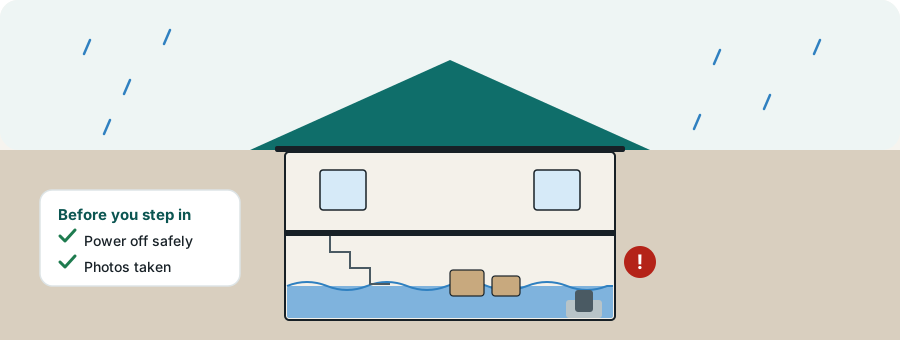
You head downstairs and your foot lands in cold water. Maybe it's an inch on the concrete. Maybe it's soaking the carpet, the storage boxes, and the bottom of the drywall. Where is it coming from? Is it safe down here? Will insurance pay?
That panic is normal. It's also when people make choices they regret, like wading in before the power is off or signing the first contract handed to them. Here's what to do first, who to call, and what to know about insurance.
We're a free referral service, not a restoration company. When you call through our site and get connected to a provider, our call-routing partner pays us for that call. We don't control providers' prices or billing.
This is general information, not legal or insurance advice. For advice about your situation, talk to your insurer, a licensed public adjuster, or a Utah attorney.
Safety first: power, gas, and dirty water
Electricity. Federal guidance says, "Do not touch electrical equipment if it is wet or if you are standing in water," and to turn off the power "if it is safe to do so" (Ready.gov). Only flip the breaker if you can reach the panel from dry ground. If the panel is in the wet basement, stay out and call an electrician.
Gas. If you smell gas, Enbridge Gas says to leave right away and not to use switches or electronics. Once you're safely away, call its 24-hour line at 1-800-767-1689 or 911 (Enbridge Gas). The Red Cross says any appliance that sat in floodwater should be checked by a professional before you use it (American Red Cross).
Carbon monoxide. Never run a gas-powered pump or generator in the basement or garage. Ready.gov says to use gas-powered machinery "ONLY outdoors and away from windows" (Ready.gov). The CDC says to keep generators at least 20 feet from doors, windows, and vents (CDC).
Dirty water. Restoration crews sort water into three categories under the IICRC S500 standard:
| Category | What it means | Common basement examples |
|---|---|---|
| 1 (clean) | Comes from a source that doesn't pose much harm to people | A broken water supply line |
| 2 (gray) | Has significant contamination | Washing machine overflow, sump pump failure |
| 3 (black) | "Grossly contaminated" and may carry germs or harmful agents | Sewage backup, rising water from rivers or streams |
Sources: IICRC (2026); Northern Arizona University.
If you see or smell sewage, keep kids and pets upstairs. Ready.gov says children shouldn't help with cleanup, and adults should wear heavy gloves, boots, and protective clothing (Ready.gov). For sewage or other contaminated water, the EPA suggests calling a professional who has experience with that kind of cleanup (US EPA).
Find where the water came from
The source decides who you call, who pays, and how the cleanup is done. Look for clues:
- Water spraying or dripping from a pipe, or running when every tap is off: a plumbing leak. Close the main shutoff valve. If a pipe froze and burst, our frozen and burst pipe guide covers the first 15 minutes step by step.
- Dirty water or a sewage smell coming up through a floor drain, toilet, or shower: a sewer or drain backup.
- Water rising out of the sump pit, or a pump that's silent: sump pump failure. If you can check from dry ground, see whether the pump has power or a breaker tripped.
- Water seeping through cracks in the floor or walls, often after snowmelt or heavy rain: groundwater or surface water from outside.
- Water coming in at window wells or doors during a storm: surface water or flooding.
Can't tell? Photograph where the water seems to enter and tell your plumber or insurer.
Who to call
| What's happening | Who to call |
|---|---|
| Sewage backing up from a floor drain in Salt Lake City | Salt Lake City Public Utilities dispatch, 801-483-6700 (24 hours) |
| Street flooding or a water main break outside | Salt Lake City Public Utilities dispatch, 801-483-6700 (24 hours) |
| A burst or leaking pipe inside your home | Shut off the main valve, then call a licensed plumber |
| Sump pump stopped or can't keep up | A licensed plumber |
| Standing water, wet carpet, or wet drywall | A water damage restoration company |
| Water near the electrical panel | An electrician |
| You smell gas | Leave, then call Enbridge Gas at 1-800-767-1689 or 911 |
| Someone is hurt or in danger | 911 |
Salt Lake City Public Utilities takes sewage backup and street flooding reports on that 24-hour line (Salt Lake City Public Utilities). Elsewhere in Salt Lake County, check your sewer bill for your provider's emergency number.
Sometimes the clog is in the public line, not your pipes. In March 2013, a blocked 12-inch sewer line sent sewage into more than a dozen Sugar House homes near 2100 South and 2000 East. The city cleared the line, and KSL reported that homeowners were told to file a claim with the city's risk management department (KSL, 2013).
How to get water out of a basement
A little clean water. A wet/dry vacuum, mops, and towels can handle a thin layer on concrete. Move rugs, boxes, and electronics somewhere dry.
Deep water. A submersible pump moves more water, but plug it in only where it's safe. For sewage or deep water, a restoration crew is usually the safer choice.
If the water came from outside, go slowly. When the soil around your house is soaked, the water in your basement helps hold the walls against that outside pressure. The Red Cross says to pump out a flooded basement gradually, "about one-third of the water per day," to avoid structural damage (American Red Cross). NDSU Extension explains that if water is pumped out too soon, "walls may be pushed in or floors pushed up" (NDSU Extension, via North Dakota Response).
Drying and mold: why the first two days matter
The EPA says, "It is important to dry water-damaged areas and items within 24-48 hours to prevent mold growth" (US EPA).
That doesn't mean it will all be dry in two days. Water wicks up drywall and soaks into carpet pad and framing, and drying can take several days with fans and dehumidifiers. Ask the crew to measure moisture daily and show you the readings.
- Soaked soft items may have to go. The Red Cross says to throw out things like mattresses and carpeting that can't be cleaned and disinfected (American Red Cross). Photograph them first.
- Don't paint over a problem. The EPA says, "Do not paint or caulk moldy surfaces." Clean and dry first.
- Small mold patches vs. large ones. The EPA says many people can clean a moldy area smaller than about 10 square feet themselves. If you have health concerns, talk to a health professional first (US EPA).
Is it safe to stay in the house?
We'd suggest staying somewhere else for now if:
- The power is off, or the electrical panel got wet and hasn't been checked
- Your furnace or water heater sat in water and hasn't been checked by a pro
- Sewage got into the basement and the cleanup hasn't started
- You smell gas, or a CO alarm goes off (leave right away)
- Someone at home has asthma or a weak immune system and you're worried (ask their doctor)
If your home isn't livable, the Utah Insurance Department says to ask your insurer whether extra living costs are covered, and to keep receipts (Utah Insurance Department).
Will insurance cover a flooded basement?
It depends on where the water came from. Here's the general picture, but your policy's wording is what counts.
| Where the water came from | What usually applies |
|---|---|
| A pipe or appliance that failed suddenly inside your home | Often covered by a standard homeowners policy, subject to your deductible and terms |
| Sewer or drain backup | Not covered by most standard policies, per the Utah Insurance Department. Usually needs a water backup add-on |
| Sump pump overflow or failure | Generally excluded from standard policies. A water backup and sump overflow add-on may cover it, up to its limit |
| Flooding or surface water from outside | Not covered by basic homeowners policies. Needs a separate flood policy, often through FEMA's NFIP |
| A slow leak over weeks or months, or poor upkeep | Usually not covered |
Sources: Utah Insurance Department, Home Claims Info; Utah Insurance Department, Flood FAQ (updated July 2026); Progressive; Amica.
A few things that surprise people:
- Backup coverage and flood coverage are not the same. Progressive notes that even with a flood policy, "your water back-up issue may not be covered." And the Utah Insurance Department says the NFIP covers sewer backup only when it's "directly caused by an active surface flood in the area."
- Flood insurance covers less in a basement than you'd think. The NFIP covers things like furnaces, water heaters, and sump pumps in a basement. It does not cover finished drywall, finished flooring, or most belongings like couches and TVs (Utah Insurance Department).
- You can't buy flood coverage after the fact. Flood policies usually have a 30-day waiting period before they start (Utah Insurance Department).
- Backup add-ons have limits. Look for a "water backup" line and dollar limit on your declarations page.
If you're not sure which policy applies, report the loss and let the insurer review it. Our guide to filing a water damage insurance claim in Utah covers the claim steps, Utah's insurer deadlines, and what to do if the payout seems low.
Document everything before cleanup
The Utah Insurance Department says to call your insurer as soon as possible, take photos and video, save all receipts, and hold off on permanent repairs until the insurer has inspected (Utah Insurance Department). Use this checklist:
- ☐ Wide video of the whole basement, then close-ups of the water line on the walls
- ☐ Photos of the source: the broken pipe, the sump pit, the floor drain, or the crack
- ☐ Photos of every damaged item before you throw it out, with brand and model if you can
- ☐ The name, date, and time of everyone you talk to (city, plumber, insurer)
- ☐ Receipts for pumps, fans, hotel stays, and meals out
- ☐ Copies of every estimate, work order, and daily moisture reading
What will it cost?
We won't guess at a number, because it depends on your basement. What drives the bill:
- How much water, and how far it spread
- What kind of water it was, clean or sewage
- How long it sat
- Finished or unfinished, since carpet, pad, and drywall add work
- Your deductible and any backup limit
Ask for a written estimate and an itemized invoice. Before you sign, our guide on picking a water damage company you can trust explains what a fair work authorization looks like and the red flags to watch for.
When it's spring runoff, groundwater, or a big storm
Groundwater. In May 2023, a Utah Geological Survey geologist told KUTV that groundwater "enters into the basements, crawlspaces or foundations through cracks or any other way it can get in." The agency released a groundwater flooding hazard map that covers the west side of Salt Lake County (KUTV, 2023).
Creek overflow. On April 12, 2023, snowmelt from Emigration Creek ran through Wasatch Hollow Park and nearby streets (Salt Lake City Emergency Management).
Heavy rain. On October 3–4, 2025, more than two and a half inches of rain fell in about 14 hours, and more than two dozen homes on Salt Lake City's west side were damaged (FOX 13, 2025). In the Willow Place neighborhood near the airport, some homes had "feet of water in their basements" after a drainage canal overflowed, KSL reported (KSL, 2025).
The Utah Insurance Department says basic homeowners policies don't cover flooding (Utah Insurance Department). So it's worth asking your agent about flood and backup coverage before the next big snow year.
The stress is real
A flooded basement can upend your week. You may be missing work and fielding calls from strangers. It's easy to say yes to the first crew just to make it stop.
It's OK to take 10 minutes to slow down. Ask how the price is set, get it in writing, and call your insurer yourself. Those steps can spare you a surprise bill later. Our Salt Lake City water damage hub has the first-hour checklist and links to every guide.
Frequently asked questions
Will homeowners insurance cover my flooded basement?
It depends on the source. A sudden pipe break is often covered. Sewer backups and sump overflows usually need a water backup add-on. Flooding from outside needs a separate flood policy.
Who do I call if sewage backs up into my basement in Salt Lake City?
Call Salt Lake City Public Utilities dispatch at 801-483-6700, 24 hours a day. In another city, check your sewer bill for the right number.
Should I pump all the water out right away?
If the water came from a pipe inside, removing it fast is usually the goal. If it came from outside and the ground is soaked, the Red Cross says to pump it out gradually, about one-third per day, to protect your walls.
Related guides
- Water damage in Salt Lake City: first steps and who to call
- Starting a water damage claim in Utah
- Restoration bill higher than insurance paid?
Sources (checked November 2026)
- Salt Lake City Public Utilities, "Utilities and Services": https://www.slc.gov/utilities/utilitiesandservices/
- Salt Lake City Emergency Management, "2023 Salt Lake City Flooding Events": https://www.slc.gov/em/2023-salt-lake-city-flooding-events/
- Utah Insurance Department, "Home Claims Info": https://insurance.utah.gov/consumers/home-insurance/home-claims-info/
- Utah Insurance Department, "Flood FAQ" (updated July 2026): https://insurance.utah.gov/wp-content/uploads/FloodFAQ.pdf
- Ready.gov, "Floods": https://www.ready.gov/floods
- CDC, "Returning Home After a Flood": https://www.cdc.gov/natural-disasters/psa-toolkit/returning-home-after-a-flood.html
- US EPA, "A Brief Guide to Mold, Moisture and Your Home": https://www.epa.gov/mold/brief-guide-mold-moisture-and-your-home
- American Red Cross, "Disaster Cleanup": https://www.redcross.org/get-help/disaster-relief-and-recovery-services/disaster-cleanup.html
- NDSU Extension Service, "Cleaning and Repairing Flooded Basements" (via North Dakota Response): https://ndresponse.gov/sites/www/files/documents/docs/cleaning-and-repairing-flooded-basements.pdf
- Enbridge Gas, "Smell Gas?" (Utah, Wyoming, Idaho): https://www.enbridgegas.com/utwyid/safety/smell-gas
- IICRC, "ANSI/IICRC S500 Consensus Body Position Statement: Category of Water Damage and Weather-related Events" (February 10, 2026): https://iicrc.org/wp-content/uploads/2026/04/Weather-Related-Position-Statement_2026.pdf
- Northern Arizona University, "Water Damage Guideline": https://in.nau.edu/wp-content/uploads/sites/226/2020/03/Water-Damage-Guideline.pdf
- Progressive, "Does Home Insurance Include Water Back-up Coverage?": https://progressive.com/answers/home-insurance-water-backup-coverage
- Amica, "Does Home Insurance Cover Water Damage?": https://www.amica.com/en/resources/severe-weather/flood/does-home-insurance-cover-water-damage.html
- KSL, "Backup leads to sewage flood in a dozen Sugar House homes" (March 16, 2013): https://www.ksl.com/article/24431417/backup-leads-to-sewage-flood-in-a-dozen-sugar-house-homes
- KUTV, "Wasatch Front homeowners seeing water bubble in basements from oversaturated groundwater" (May 5, 2023): https://kjzz.com/news/local/wasatch-front-homeowners-seeing-water-bubble-in-basements-from-oversaturated-groundwater-flooding-st-george-salt-lake-county-water-property-damage-spring-runoff-snowmelt
- FOX 13, "State of emergency declared after dozens of Salt Lake City homes flooded" (October 7, 2025): https://www.fox13now.com/news/local-news/northern-utah/state-of-emergency-declared-after-dozens-of-salt-lake-city-homes-flooded
- KSL, "Photos: Downpour hits northern Utah, flooding nearly 2 dozen homes in Salt Lake City" (October 4, 2025): https://www.ksl.com/article/51385419
Update log
- November 6, 2026: First published.