Home › Salt Lake City › Ceiling leak
Water Leaking Through the Ceiling: What to Do First in Salt Lake City
Do this now
- Stay out from under a sagging or bulging ceiling. Wet drywall and plaster are heavy and can fall without warning.
- Keep away from wet lights and outlets. Turn off power to that area only if you can reach the breaker while standing on dry ground.
- Stop the water if you can. Turn off the fixture's valve or close your home's main water shutoff.
- Live in a condo or townhome? Knock on the door of the unit above, then call your HOA or property manager.
- Catch the drip and take photos. Put down a bucket and towels, then photograph the ceiling and anything that got wet.
- Start drying within a day or two. The EPA says to dry wet areas within 24 to 48 hours to help prevent mold.
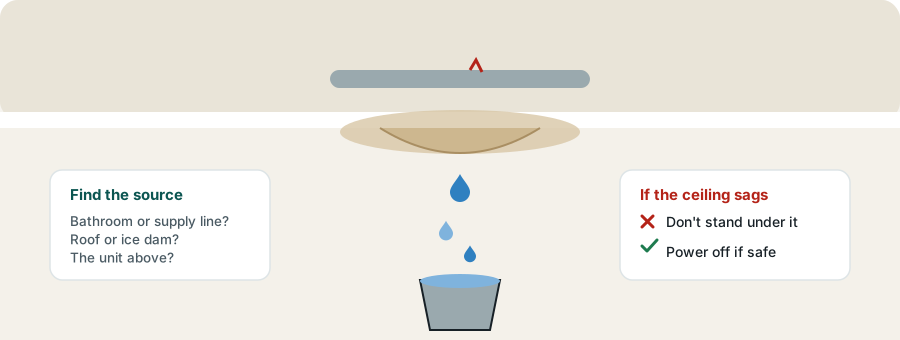
There's a brown stain on the ceiling that wasn't there yesterday. Or water is dripping onto the carpet. You're not sure where it's coming from, whether the ceiling will hold, or who you're even supposed to call.
It's normal to feel stuck. A ceiling leak can be a plumbing problem, a roof problem, or a problem in someone else's unit. This guide covers staying safe, finding the source, calling the right person, and protecting yourself when you deal with insurance and the bill.
We're a free referral service, not a restoration company. When you call through our site and get connected to a provider, our call-routing partner pays us for that call. We don't control providers' prices or billing.
This is general information, not legal or insurance advice. For advice about your situation, talk to a Utah attorney or a licensed public adjuster.
Is a leaking ceiling an emergency? How to tell if it's serious
Often, yes. Treat it as urgent if you notice any of these signs:
- A sag or bubble. A bulge means water is pooling behind the ceiling (Mercury Insurance, 2025).
- Cracks, soft spots, or crumbling drywall. The material is soaked and getting weaker.
- Water near anything electrical, like a light, ceiling fan, or smoke detector.
- A steady flow, not just a slow drip, or a stain that keeps growing.
- Running-water sounds when nothing in the house is on.
- A source you can't find or stop.
Even a small stain is worth acting on today. Water can soak into insulation above the ceiling before it shows through, so what you see may be only part of it.
If anyone is hurt or in danger, call 911.
Safety first: sagging ceilings and electricity
Don't stand under a sag
FEMA and the American Red Cross warn that your ceiling "may be holding water," and that "wet plaster or wallboard is very heavy and dangerous if it falls" (FEMA and American Red Cross, Repairing Your Flooded Home). Move people, pets, and valuables out of the room.
About poking a hole to drain it
You may have heard you should poke a hole in a bulging ceiling. The FEMA and Red Cross guide does say: "Poke a hole in the ceiling at the edge of the sag so any trapped water can begin to drain." It also warns, "Do not start at the center of the sag because the ceiling may collapse suddenly." Mercury Insurance also mentions draining a bulge with a small hole, but says to "only do this if the area is safe to access."
In plain terms:
- You don't have to do this. If the sag is large or cracking, or you feel unsure, leave and call a pro.
- Stay away from lights, fans, and wiring. If a fixture is anywhere close, leave it to a pro. Otherwise, turn off power to that area first, from a dry spot.
- Set a big bucket and a tarp below first, and stand to the side, not underneath.
Water and electricity
Ready.gov says, "Do not touch electrical equipment if it is wet or if you are standing in water," and to turn off electricity "if it is safe to do so." Don't flip a wet light switch. If you'd have to step in water to reach your breaker box, the FEMA and Red Cross guide says to call an electrician.
Finding the source of the leak
A few clues will help you call the right person. What's above the wet spot: a bathroom, kitchen, laundry room, attic, roof, or a neighbor's unit? And when does it drip: only when someone showers upstairs, only when snow is melting, or all the time?
Plumbing
If there's a bathroom above the stain, check the toilet, tub, shower, and sink. A Connecticut Insurance Department pamphlet, citing a study by the Insurance Institute for Business & Home Safety (IBHS), says most toilet-related water damage came from faulty supply lines, toilet flanges, and fill valves. It also names washing machine supply lines and water heaters as common sources (Connecticut Insurance Department).
A quick test: turn off the water at the main shutoff. If the dripping slows or stops after a while, it's likely plumbing. Our frozen and burst pipe guide shows how to find and close your main valve.
Heating and cooling
Is there a furnace or air conditioner in the attic or above the wet spot? A clogged condensate drain can overflow the drain pan, "causing water damage inside the house," including ceilings, according to the trade publication ACHR News.
The roof, and Utah ice dams
If the leak shows up during a storm or while snow is melting, suspect the roof. In the IBHS study cited by the Connecticut pamphlet, roof leaks were the most frequent source of water damage.
Salt Lake winters add one more cause: ice dams. Snow melts on the warm part of the roof and refreezes at the colder edge. KSL explains that the ice can lift shingles, and then "the ice can melt under the shingles and drop winter's dew right into your living space" (KSL, 2012). In March 2023, KSL reported on a Park City home where an ice dam pushed water under the shingles and brought down part of a ceiling (KSL, 2023).
Don't climb onto a snowy or wet roof. Mercury Insurance warns that wet roofs are slippery and dangerous, and suggests calling a licensed roofer.
The unit above you
In a condo or townhome, the leak may start upstairs or next door. Knock right away and ask your neighbor to check their toilet, tub, sinks, dishwasher, and washer. If no one answers, call your HOA or property manager.
You don't need to settle who's at fault today. You just need the water stopped and the damage on record.
Who to call
| What you're seeing | Who to call first |
|---|---|
| Ceiling sagging, cracking, or falling, or someone is hurt | Leave the room. Call 911 if anyone is in danger. |
| Water dripping from or near a light, fan, or outlet | An electrician (turn off power only from a dry spot) |
| Leak under a bathroom, kitchen, or laundry room, or drips that never stop | A licensed plumber |
| Water near an attic furnace or air conditioner | An HVAC technician |
| Leak during rain or snowmelt, or ice along the roof edge | A licensed roofer |
| Water coming from the unit above you | Your neighbor, then your HOA or property manager |
| Soaked drywall, insulation, or carpet after the source is stopped | A water damage restoration company |
| Damage you plan to claim | Your insurance company (call it yourself) |
You may need more than one: a plumber or roofer fixes the source, and a restoration company dries the house. The Salt Lake City water damage hub covers other first steps.
Before anyone starts big work, ask a few questions. Check that a roofer or contractor holds a Utah license on the state license lookup, and get in writing how they'll price the job. Our guide to choosing a water damage company in Salt Lake City lists the red flags.
Document it before you clean up
Good records make insurance and HOA talks easier. The Utah Insurance Department says to call your insurer as soon as possible, take photos or video, and make the repairs needed to prevent more damage. It also says, "Do not have permanent repairs made until your insurance company has inspected the property," and to save all receipts (Utah Insurance Department).
Take wide photos of each room, then close-ups of the stain, the sag, and wet items. Photograph the source once it's found, keep any broken part a plumber removes, and write down when you first saw the leak and who you talked to.
Does insurance cover water leaking through the ceiling?
Sudden leaks are more likely to be covered. The National Association of Insurance Commissioners says homeowners policies cover damage from a "sudden and accidental" discharge from your plumbing (NAIC, 2024).
Slow leaks often aren't. Washington State's insurance regulator says most policies don't cover gradual leaks, or the extra damage from putting off repairs (Washington OIC). Policies vary, but that's one more reason to act on a stain now.
Roof leaks are tricky. The Utah Insurance Department says most standard policies don't cover interior storm water damage when "there is no damage to the roof or walls of your home." Ice dams can be different. A State Farm agent told KSL, "Typically, broadly speaking, ice dams are covered when you have interior water damage" (KSL, 2023). Ask your insurer how your policy applies.
For the full process, including timelines and what to do about a low payout, see our Utah water damage insurance claim guide.
Condos and townhomes: the HOA's policy and deductible
If your HOA insures the building, Utah law shapes who pays. Under the Condominium Ownership Act, the association's policy is primary, and a unit owner can owe a share of the association's deductible when their unit is damaged in a covered loss. That share is based on how much of the damage was to their unit. The association must tell owners about this and about any change in the deductible (Utah Code 57-8-43). The Community Association Act has similar rules for many townhome HOAs (Utah Code 57-8a-405).
The Utah Insurance Department suggests reviewing your CC&Rs, bylaws, and the association's policy with your agent so your own policy fills the gaps (Utah Insurance Department). If you and a neighbor or the HOA disagree about who pays, talk to a Utah attorney.
How expensive is it to fix a leaking ceiling?
We won't give you a number, because an honest one isn't possible without seeing the damage. A small stain from a quick fix is a modest job; a soaked ceiling plus a roof repair is a much bigger one. What drives the cost:
- The source repair. A new toilet supply line is very different from a roof repair.
- How far the water spread. Wet insulation, framing, and floors below add up.
- Whether the ceiling has to come down. Soaked drywall may need to be cut out, and the FEMA and Red Cross guide says to remove wet ceiling insulation so the joists can dry.
- Who pays. Your insurer, the HOA, a neighbor's insurer, or you.
Ask for a written, itemized estimate before work starts. If the final bill is higher than what insurance pays, here's what to do when the restoration bill tops your payout.
Drying the ceiling and the mold risk
Once the source is fixed, get everything dry. The EPA says, "It is important to dry water-damaged areas and items within 24-48 hours to prevent mold growth" (US EPA).
- Ceilings hide water. Insulation may stay wet after the surface feels dry. Ask the crew to measure moisture and share the readings.
- Some materials can't be saved. The EPA says porous materials "such as ceiling tiles and carpet" may have to be thrown away if they get moldy.
- Don't paint too soon. The EPA says, "Do not paint or caulk moldy surfaces." Wait until the area is dry and the cause is fixed.
- Small mold vs. big mold. The EPA says you can usually clean a moldy area smaller than about 10 square feet yourself. For bigger areas, it points to its more detailed cleanup guide. If sewage or other dirty water caused the damage, it suggests hiring a professional with that experience.
Ceiling leak checklist
- ☐ Get everyone out from under any sag.
- ☐ Turn off power to wet lights and outlets, only from a dry spot.
- ☐ Stop the water, or alert the unit above.
- ☐ Catch the drip and move valuables.
- ☐ Take photos and video before cleanup.
- ☐ Call the right pro: plumber, roofer, or HVAC technician.
- ☐ Call your insurer, and your HOA if you have one.
- ☐ Start drying within 24 to 48 hours.
Frequently asked questions
Can a ceiling leak wait until morning?
If it's a slow drip, the ceiling looks flat, and no water is near electrical fixtures, you can catch it with a bucket and shut off the water while you wait. If the ceiling is sagging, the leak is getting worse, or water is near wiring, don't wait.
Who pays if the leak came from my upstairs neighbor?
It depends on what failed, your HOA's rules, and the policies involved. In Utah, if the HOA insures the building, state law generally makes its policy primary, and you may owe part of its deductible. Report it to your HOA and your insurer, and keep your records.
Can I just paint over the water stain?
Not yet. Fix the leak and let the ceiling dry completely first. The EPA says not to paint or caulk moldy surfaces, and paint put over mold is likely to peel. If the stain comes back after you paint, water may still be getting in.
Related guides
- Salt Lake City water damage help: first steps and who to call
- Filing a water damage claim in Utah
- How to vet a restoration company before you sign
Sources (checked November 2026)
- FEMA and American Red Cross, "Repairing Your Flooded Home" (copy posted by the Town of Kitty Hawk, North Carolina): https://www.kittyhawknc.gov/wp-content/uploads/2018/02/Red_Cross_-_Repairing_Your_Flooded_Home.pdf
- Ready.gov, "Floods": https://www.ready.gov/floods
- US EPA, "A Brief Guide to Mold, Moisture and Your Home": https://www.epa.gov/mold/brief-guide-mold-moisture-and-your-home
- Utah Insurance Department, "Home Claims Information": https://insurance.utah.gov/consumers/home-insurance/home-claims-info/
- Utah Insurance Department, "Condo/Townhome Owners Insurance": https://insurance.utah.gov/consumers/home-insurance/condo-townhome/
- Utah Legislature, "Utah Code 57-8-43, Condominium Ownership Act, Insurance": https://le.utah.gov/xcode/Title57/Chapter8/57-8-S43.html
- Utah Code 57-8a-405, Community Association Act, Insurance: https://le.utah.gov/xcode/Title57/Chapter8A/C57-8a-S405_1800010118000101.html
- National Association of Insurance Commissioners, "Will My Homeowners Insurance Policy Cover Water Damage from a Burst Pipe?" (February 8, 2024): https://content.naic.org/article/will-my-homeowners-insurance-policy-cover-water-damage-burst-pipe
- Washington State Office of the Insurance Commissioner, "Leaks, water intrusion and mold": https://insurance.wa.gov/homeowner-insurance-and-mold
- Insurance Institute for Business & Home Safety (posted by the Connecticut Insurance Department), "Quick Tips to Prevent Water Damage": https://portal.ct.gov/cid/-/media/cid/waterdamagepamphletctdoipdf.pdf
- Mercury Insurance, "Does Homeowners Insurance Cover Roof Leaks?" (November 11, 2025): https://www.mercuryinsurance.com/resources/home/what-to-do-if-your-roof-is-leaking.html
- ACHR News, "Ensuring Proper Condensate Drain Management" (June 20, 2016): https://www.achrnews.com/articles/132764-ensuring-proper-condensate-drain-management
- KSL, "Ice dams above your ceiling, cursing beneath" (October 3, 2012): https://www.ksl.com/article/22241292/ice-dams-above-your-ceiling-cursing-beneath
- KSL, "What kind of snow damage does insurance cover?" (March 10, 2023): https://www.ksl.com/article/50597267/what-kind-of-snow-damage-does-insurance-cover
- Utah Division of Professional Licensing, License Lookup: https://secure.utah.gov/llv/search/index.html
Update log
- November 6, 2026: First published.